
When poverty overcame Ireland in the early to mid-1800s, the delicate craft of lace making was born. During that difficult time Irish lace became a source of income for young, poor Irishwomen, especially after the potato famine swept Ireland between 1845 and 1851.
The introduction of lace making to Ireland is attributed to the Ursula nuns and to Mademoiselle Riego de Blanchardiere, the daughter of a Franco-Spanish nobleman and an Irish mother. But whoever deserves the credit for introducing this craft to Irish people, it is true that Irish lace was heavily influenced by Venetian needlepoint lace, another technique from Italy, just as beautiful but far more labor intensive.
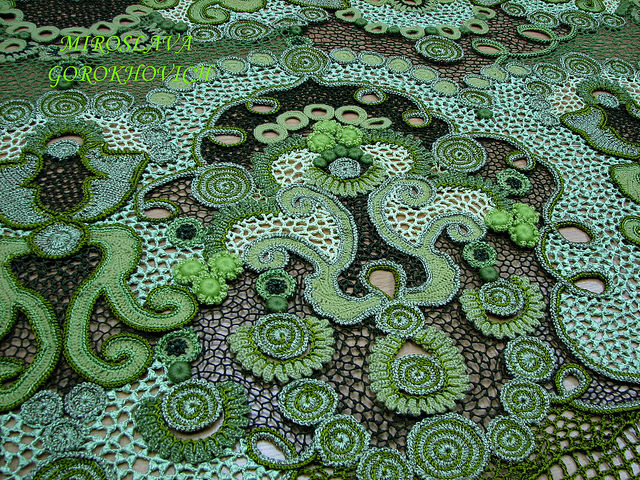
Irish Crochet lace is worked with three different thread weights: a fine thread for the crocheted motifs; a slightly heavier thread is used as a foundation cord; and even finer thread is used for the background - netting. Irish lace pattern pieces are crocheted individually, using several basic crochet stitches over the heavier foundation thread, to form rings, leaves, flowers. After all the pieces are finished, they are arranged and sewn onto heavy paper or cloth and the spaces in between them are filled in with different netting using the finest crochet hook and thread. Once the entire work is finished, it is removed from the paper or cloth.
Irish lace quickly became a popular choice in the major cities of the world: Paris, London, Dublin and San Francisco, a major distribution center for the lace until the 1906 earthquake. Lace making was a true cottage industry, with individual young women working on the designs in their homes, then taking them to another location where other, specially trained people would crochet the pieces together into collars, trimmings, parasols and even entire wedding gowns.
Irish Crochet needle workers were very careful in keeping their patterns secret and jealously guarded them from other lace makers. When visitors came, these workers would hold them at the front door until unfinished lace could be hidden from sight for fear of the theft of their designs. It was a common practice in that time for each person to become skilled in making one thing and one thing only, such as a leaf or a flower. Another person would then crochet the different pieces together using a background mesh.
The popularity of Irish Lace grew significantly during the late 1800s and into the early 1900s, but began to wane as fashions changed. Much of the work seen today in lace museum displays and private collections dates from the 1880s.
The true Irish Lace is rare and deeply valued even today.
On the pages of this site you will find outstanding works of Ukrainian and Russian designers. Their exquisite Irish crochet garments - inspired by the flowers, leaves and netting of Irish crochet - are beautifully laid out in intricate patterns and colors.
The type of netting they use is not made with a repeated pattern but grows organically, as in nature. Their level of skill, amazing talent, and experience allows them to create truly beautiful pieces of art, like fine brushwork in a painting.
Irish Crochet Lace is an old technique of crochet lace without any seams. Individually made motifs: flowers, leaves, rosettes, are crochet separately and then combined with a special netting technique that leaves the garment completely seamless.
Our designers use only thread, a hook and their hands to make these gorgeous outfits. Due to unmatched craftsmanship you will never find another identical piece.
Irish Crochet is labor-intensive and very hard work, but it yields the most beautiful and intricate looking garments.
Our Story


The History of Irish Crochet